A damaged phone does not automatically need replacing, but repair is not automatically the best answer either. The sensible route depends on what is actually wrong, whether the device is safe to handle, the repair support available for that model, and what a confirmed repair would cost compared with the phone’s remaining usefulness.
Start With the Decision, Not the Damage
Begin by separating the visible symptom from the underlying fault. A cracked screen is easy to see; a phone that will not charge, overheats or has stopped responding may have several possible causes. Use the manufacturer’s available troubleshooting or diagnostic route before assuming which part needs replacing. Samsung’s UK repair service, for example, directs owners through troubleshooting before repair booking, while Fairphone puts diagnosis ahead of choosing a repair route. (source) (source)
Then compare three realistic options: a documented DIY repair, a manufacturer or qualified professional service, and replacement. The decision is not simply about the lowest initial price. Consider safety, whether the fault is known, the availability of suitable parts and instructions, any remaining cover, the need to protect your data, and how long the phone is likely to remain useful after the repair.
If a route depends on an inspection or quote, treat early prices as provisional rather than as a final comparison. That keeps you from committing to a repair—or a replacement—on an assumption.
Diagnose the Fault and Set Safety Boundaries
Start with what you can observe without opening the phone. Note when the issue began, whether it followed a drop or liquid exposure, whether charging behaviour has changed, and whether the problem occurs with a known-good cable, charger or accessory. Use only the approved diagnostic or support process available for your device; a symptom is not confirmation that a particular component has failed. (source) (source)
Stop and seek professional advice if the device appears physically unsafe, if the fault is unclear, or if the phone needs to be opened before you can confidently identify the work required. Do not turn uncertainty into a DIY diagnosis. Fairphone explicitly distinguishes between repairs that can be done at home and problems that may be too complex for DIY, in which case its repair centres investigate in more detail. (source)
Before sending a phone away or handing it over, make a current backup if it can be done safely. Record the model, storage capacity, condition and any accessories you provide. For a device that still has service coverage, check the relevant manufacturer or insurer process before authorising work: the diagnostic route may identify a covered option, while an independent repair decision may affect the value of that cover.
The aim at this stage is modest but important: establish whether you have a safe, well-understood repair task, or whether you need a professional diagnosis before comparing routes.
When DIY Repair Can Be a Sensible Option
DIY repair is most credible when the phone has a clearly supported repair path, the fault has been diagnosed, and you can obtain the correct part, tools and instructions for that exact model. Repairability is not a general property of every phone, and a task that is straightforward on one model can be unsuitable on another.
Fairphone provides a useful example of what supported DIY looks like. Its repair process asks owners to diagnose the issue first, then offers DIY alongside send-in repair. It identifies the relevant spare part, a Phillips 00 or Torx T5 screwdriver, and the appropriate repair guide as prerequisites. Its published guides cover components including batteries, displays, cameras and earpieces, and loudspeaker and USB-C port assemblies for supported models. (source)
That does not make every listed repair right for every owner. Choose DIY only when you can follow the model-specific documentation from start to finish, have the required parts and tools, and can pause without pressure if the repair does not match the diagnosis. A repair that becomes uncertain partway through is a reason to reassess, not to improvise.
DIY may suit an owner who values repairability and is comfortable with a bounded, documented task. It is less suitable where the device’s condition, component compatibility, coverage position or final outcome cannot be established with confidence in advance.
When Professional Repair Is the Better Fit
Professional repair is often the better fit when the problem is complex, intermittent, safety-sensitive or still uncertain after basic checks. It also gives you a route where someone else can inspect the device, explain the available options and provide a service estimate before work proceeds.
Apple’s UK service information illustrates the distinction between an advertised estimate and the final charge: Apple says it needs to inspect the product to determine the final service fee, and notes that a delivery fee may apply for send-in repair. Apple Authorised Service Providers set their own service fees and provide their own estimates. (source)
For iPhone owners considering Apple’s service routes, Apple says its trained technicians inspect the device and explain the options; it also states that Apple-certified service uses genuine Apple parts. Its support journey includes in-person and postal service options, estimates and repair-status communication. (source) Samsung similarly offers troubleshooting followed by repair booking when a repair is needed, including routes for devices in and out of warranty. (source)
An independent repairer can also be a valid option, but ask focused questions before you book: What diagnosis has been made? Which part will be fitted? Is the part source clearly explained? What happens if inspection changes the scope or price? How will your device and data be handled? A clear answer does not guarantee an outcome, but it makes the comparison more accountable.
Compare the Risks, Costs and Whole-Life Value
Compare like with like. Put the confirmed or estimated repair price beside the cost of a suitable replacement—not merely the price of the newest phone. Include possible inspection, delivery or service fees, accessories you would need to replace, and the practical value of keeping your existing data, setup and familiar device. Apple notes that out-of-warranty estimates are subject to VAT, that inspection determines the final service fee, and that delivery fees can be added for a send-in repair. (source)
A lower initial DIY price may not represent lower total cost if the correct part, tools or a second repair are needed. Professional service can cost more upfront, but may be preferable where inspection, documented parts, service communication or a clear route for an uncertain fault matters. Conversely, a repair quote can make replacement reasonable if the phone has other serious limitations, lacks an appropriate repair path, or is unlikely to offer enough useful life after the work.
Coverage is another comparison point. Fairphone recommends diagnosis first because some repairs may be covered by warranty; Apple and Samsung both route owners through support and service processes that account for repair needs and coverage circumstances. (source) (source) (source) Check the terms that apply to your device before choosing a route, rather than assuming that a repair will or will not preserve remaining cover.
Privacy and continuity deserve equal attention. Back up what you can, remove or secure sensitive information in line with the service provider’s instructions, and confirm how you will manage authentication, payment apps and recovery codes while the device is unavailable. Apple says it designs its service process to minimise the data technicians can access, but you should still prepare your own account and backup plan. (source)
Whole-life value is therefore a judgement, not a universal rule. Repair can be sensible when it restores a supported phone at a proportionate cost. Replacement can be sensible when a safe, documented repair is unavailable or the complete cost and likely remaining life no longer compare well.
Use This Decision Path Before You Spend
AI-generated generic editorial illustration — not a retailer product photo and does not depict the reviewed product or service. Give readers a fast, safety-led visual framework before they compare repair routes.
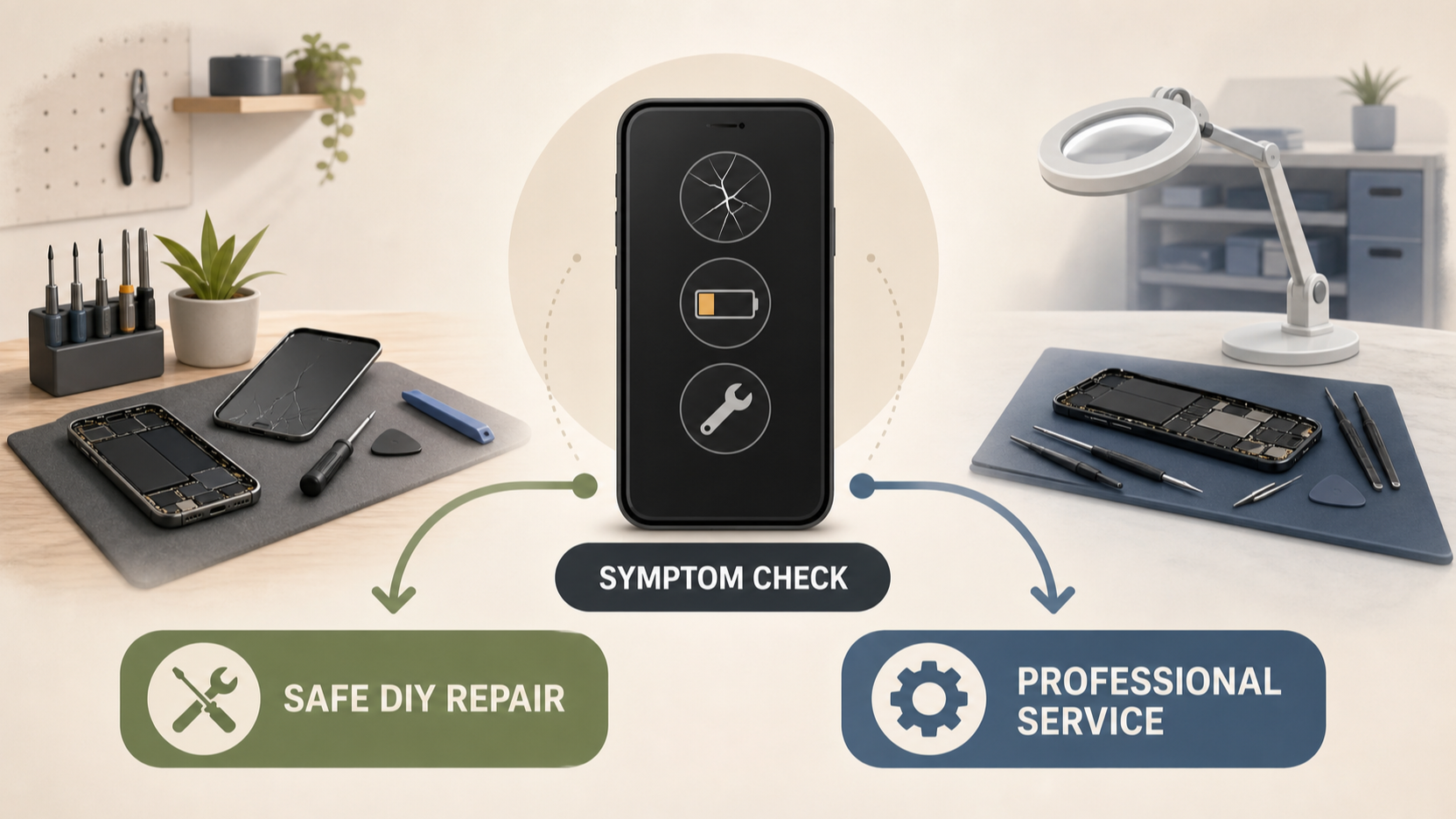 Use this sequence to choose a next action without treating it as a repair instruction.
- Describe the symptom. Record what happened and try the manufacturer’s available troubleshooting or diagnostic route. Do not assume a component has failed from one symptom alone. (source) (source)
- Set a safety stop. If the phone appears unsafe, needs opening before the fault is understood, or the task is beyond your confidence, move to professional assessment.
- Check support and cover. Find the exact model and review the manufacturer, warranty, insurance or service options that apply before authorising work. Fairphone notes that diagnosis can identify repairs covered by warranty; Samsung’s flow also distinguishes repair and Care+ claim routes. (source) (source)
- Back up and document. Where safe, make a backup and note the device’s condition before it changes hands.
- Test the DIY case. Proceed only if you have a model-specific guide, suitable part, required tools and a clearly bounded task. Fairphone’s DIY route explicitly identifies these prerequisites. (source)
- Test the professional case. Ask for a diagnosis or estimate, confirm the parts and service process, and allow for inspection changing the final fee. Apple states that final out-of-warranty charges depend on inspection. (source)
- Compare against replacement. Replace when no safe, adequately documented repair route is available, or when the total repair case does not offer proportionate remaining value for your needs.
Your next action may simply be to obtain a diagnosis or quote. That is often the most defensible decision when the fault, final cost or coverage position remains uncertain.
Frequently Asked Questions
Is it worth repairing a phone with a cracked screen?
It can be, but the crack alone is not enough to decide. Identify the exact model, check whether touch, display and other functions are affected, and compare a confirmed repair route with the phone’s remaining usefulness. A manufacturer service may require inspection before it can give the final fee, so use a quoted or estimated price as one input rather than an automatic verdict. (source)
Should I use a manufacturer repair service or an independent repair shop?
Choose the route that gives you the clearest answer for your device and fault. Manufacturer services can provide their own diagnostic, booking and coverage paths; Apple says its authorised providers provide their own estimates, while Samsung directs owners through troubleshooting before repair booking. (source) (source) For any independent shop, ask about the diagnosis, part source, revised-price process and data handling before you approve work.
Can I repair my phone myself without losing warranty cover?
Do not assume either answer. Check the terms that apply to your device and diagnose the issue before choosing a repair route. Fairphone specifically says some repairs may be warranty-covered and recommends diagnosis first; its supported DIY process is tied to the relevant part, tools and repair guide. (source) If the coverage position matters, obtain confirmation from the relevant provider before starting work.
When is replacing a damaged phone more sensible than repairing it?
Replacement can be the better choice when the fault cannot be safely or confidently assessed, a suitable repair route is unavailable, or the confirmed total repair case does not justify the phone’s likely remaining usefulness. Compare the complete repair cost—including any inspection or delivery charges—with a replacement that meets your actual needs. Do not treat either repair or replacement as the default answer. (source)
Related reading
- Best phones for repairability in the UK: comparing Apple, Samsung, Google Pixel and Fairphone repair support
- iFixit mobile repair review: device guides, replacement parts, tool range and practical limits
- Fairphone repairability review: modular parts, repair guides, tool needs and practical limitations
- When repairing an older phone offers better value than replacing it
Editorial information: About our editorial team · Read our editorial policy · Read our affiliate disclosure.